YELLOW BIRD
A new novel · September 2026

Cherokee writer · 1827–1867 · signed "Yellow Bird"

John Rollin Ridge

The poet who became the outlaw's biographer.

He survived the murder of his father, killed a man, and ran to the California gold fields. When the gold failed him he picked up a pen instead — and wrote the bandit Joaquín Murrieta into a legend that outlived them both. This is the history of the first Native American novelist, and the home of the forthcoming novel Yellow Bird.

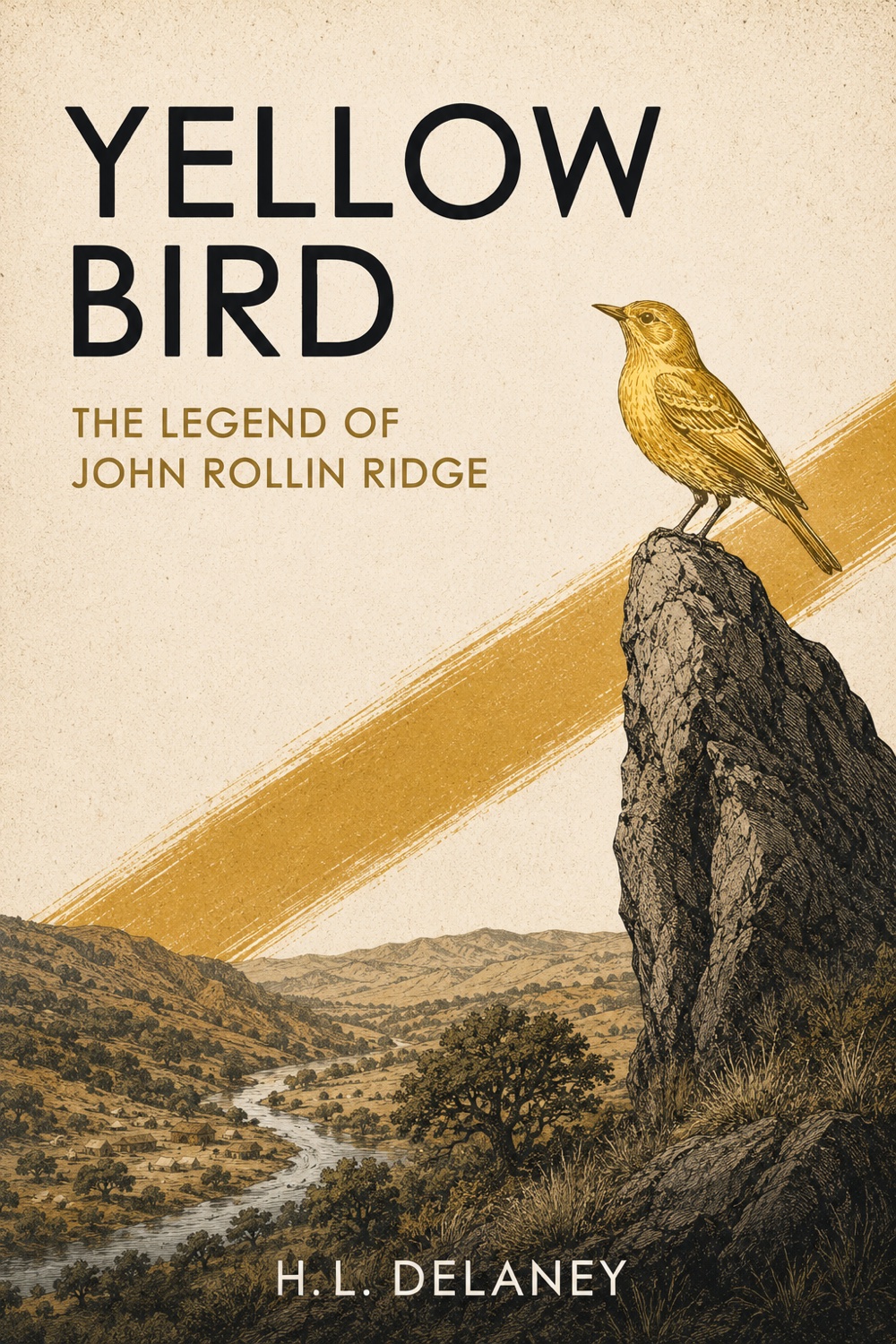
Cover of Yellow Bird: The Legend of John Rollin Ridge by H.L. Delaney — a gold meadowlark on a crag above a California valley.

A Cherokee man with two names and one wound.

John Rollin Ridge was born on March 19, 1827, in the Cherokee Nation in what is now Georgia. His people called him Cheesquatalawny — Yellow Bird. He was the grandson of Major Ridge and the son of John Ridge, two of the most powerful men in the Nation, and that inheritance would cost him almost everything before he was a grown man.

He grew into a poet and a newspaper editor, fluent in the polished English of the eastern schools and never quite at home in it. He died at forty in Grass Valley, California, in 1867. In the years between he wrote the first novel ever published by a Native American — and built, almost as a side effect, one of the most durable folk legends the American West has ever produced.

Born 1827

Cherokee Nation

Born at New Echota, Georgia, into the Ridge family — leaders, landholders, and signers of a treaty that would get them killed.

"Yellow Bird"

Cheesquatalawny

His Cherokee name, and the name he signed to his fiction. The man wrote from behind it the way Joaquín wore a mask.

1854

The first Native novel

The Life and Adventures of Joaquín Murrieta — widely recognized as the first novel by a Native American author, and the first published in California.

Died 1867

Grass Valley, California

A frontier editor to the end, dead at forty, still arguing for the Cherokee in print two thousand miles from home.

The morning the men came

In 1835 a small faction of Cherokee leaders — Major Ridge, his son John Ridge, and his nephew Elias Boudinot — signed the Treaty of New Echota. They had concluded that removal was coming whether the Nation agreed or not, and that a negotiated price was better than a forced march for nothing. They signed away the eastern homeland. Most of the Nation never forgave it. The Trail of Tears followed, and thousands died on the road west.

Cherokee law held that ceding the common land without the Nation's consent was a capital crime. On June 22, 1839, that law was answered. In coordinated attacks across the new territory in present-day Oklahoma, men came for all three signers in a single morning. John Rollin Ridge was twelve years old. He watched them stab his father to death in the yard while his mother knelt in the mud trying to hold the wound closed.

The novel Yellow Bird opens here — not with genealogy or argument, but with a barefoot boy in a doorway learning, before he has the words for any of it, what a body and a piece of paper can cost.

He carried the feud to California

The family fled to Arkansas. Ridge was schooled, married Elizabeth Wilson, started a family, and tried to read law — but the politics that had killed his father were still alive, and in 1849 they found him again. In a dispute tangled up with the old factional hatred, Ridge killed a man named David Kell. Knowing the courts were controlled by his family's enemies, he ran.

He ran the way thousands of men ran in 1849: toward the gold. He reached California in 1850 and the gold did not rise to meet him. He failed at mining, failed at trading, and watched foreign-born miners get taxed, robbed, and lynched under a state that called itself the Golden Republic. When prospecting broke him, he turned to the one mine that paid — the newspapers — and found that he could write.

The Life and Adventures of Joaquín Murrieta

In 1853 California was hunting a ghost. A string of robberies and killings across the gold country was blamed on a Mexican bandit named Joaquín — though witnesses kept naming five different Joaquíns, and nobody could say which was real. In May the legislature authorized a company of Rangers under Harry Love to hunt him down. That July, Love's men killed a Mexican at Cantua Creek, cut off his head and the hand of a companion called Three-Fingered Jack, and preserved them in jars of whiskey. The state put the head on display as proof. Plenty of people who paid their dollar to see it doubted, out loud, that it had ever belonged to anyone named Joaquín.

In 1854 Ridge took that confusion and gave it a shape. Writing as Yellow Bird, he published The Life and Adventures of Joaquín Murrieta, the Celebrated California Bandit — a wronged man driven to vengeance by Anglo miners who seized his claim, beat him, and hanged his brother. It was, by most accounts, the first novel written by a Native American and the first published in California. And it was a kind of confession in disguise: a dispossessed man writing a dispossessed man, pouring his own family's grief into a Mexican outlaw the law could safely hate.

I sit down to write somewhat concerning the life and character of Joaquín Murrieta, a man as remarkable in the annals of crime as any of the renowned robbers of the Old or New World. John Rollin Ridge, opening line, 1854

The book sold, was pirated, translated, and rewritten for a century. Murrieta became a folk hero in California, Mexico, and Chile; Pablo Neruda wrote a play about him; and the masked-avenger mold Ridge poured fed straight into Zorro and everything after. Ridge himself made almost nothing from it. The legend got away from him the way the name Joaquín had gotten away from the state — too useful to too many people to belong to any one of them.

Why "Yellow Bird"

Cheesquatalawny was the name his own people gave him, and it is the name he chose to sign when he wrote the outlaw into being. There is something exact about that choice. A man who had learned at twelve to keep silent in a yard full of killers wrote his own grief into a stranger's life and signed it with the name from before all of it — the boy's name, the Cherokee name, the name the eastern schools had tried to polish off of him.

He never stopped writing. He edited papers up and down California — Sacramento, Marysville, Grass Valley — feuded in print, wrote poems, and argued for the Cherokee from two thousand miles away even as he made a separate, quieter peace with the country that had taken everything. His poem "Mount Shasta" still turns up in anthologies. He was assimilated and unassimilable at once, and he wrote from inside that contradiction until his body gave out in 1867.

Cover of Yellow Bird: The Legend of John Rollin Ridge by H.L. Delaney.

Yellow Bird

The Legend of John Rollin Ridge — a novel by H.L. Delaney

The record leaves a gap exactly the size of a man. Ridge reached California in 1850 and failed; Joaquín rode out of nowhere the same year. Ridge fell ill and faded from the gold country; Joaquín's head went into a jar. Then a broke editor sat down in 1854 and wrote the outlaw's whole life as if he had it by heart.

Yellow Bird steps into that gap and stays there. It tells the story as if John Rollin Ridge became Joaquín Murrieta — and never once stops to argue it. The records are allowed to behave like records: partial, useful, and not quite gospel. Body to name to mask to the head the state needed, and finally to the desk, where a man turns his crimes into a story and signs it with a boy's name.

Coming September 2026 from Basalt Sea Press · a Native-owned house.

H.L. Delaney

H.L. Delaney is a novelist and an enrolled member of the Klamath Tribes, with Modoc ancestry. His work returns to the same hard ground: Native lives caught in the machinery of American expansion, told without romance and without flinching. Yellow Bird is his novel of John Rollin Ridge.

More at hldelaney.com.

Go deeper

Short, sourced pieces on the real history beneath the legend — who Ridge was, whether Joaquín Murrieta existed, the killing of the Ridges, and the strange afterlife of a Gold Rush ghost.

Enter the Reading Room →